
Most candidates are prepared for your first question. Very few are prepared for the follow-up. In this article, Travis Janko explains why the second question reveals more than the first and how founders can use simple follow-ups to uncover ownership, coachability, and real-world performance during interviews.
A founder once told me something that made me laugh.
"Travis, I don't get it. Every candidate sounds great."
At first, that sounds like a good problem to have. A strong candidate pool. Plenty of qualified people. Lots of options.
In reality, it's usually a sign that the interview process isn't doing its job.
I asked him to walk me through how he was interviewing candidates. The questions sounded familiar because they're the same questions most hiring managers ask.
Tell me about yourself.
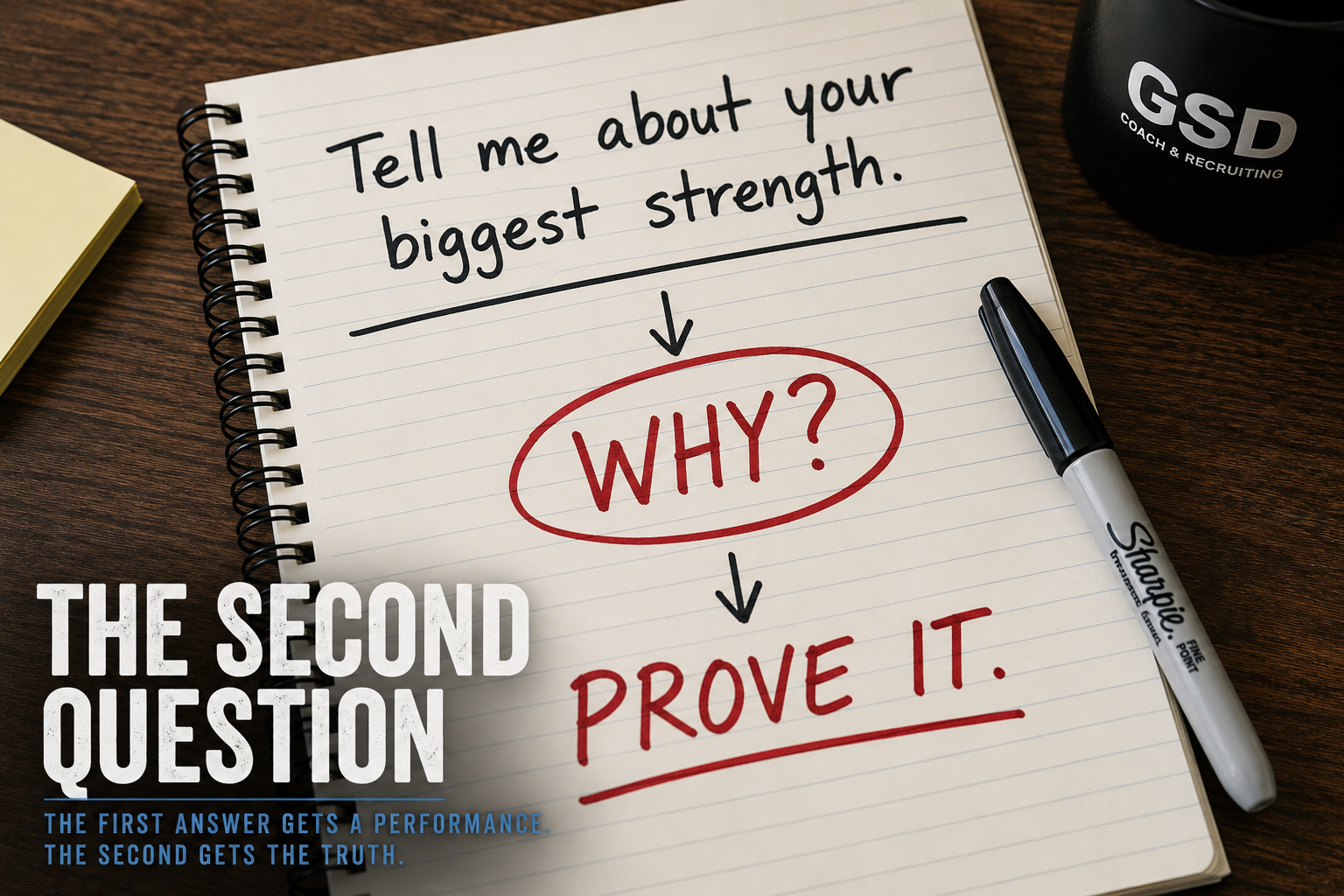
What's your biggest strength?
Why are you interested in this role?
How would your previous manager describe you?
There was nothing wrong with any of the questions. The problem was that every interview stopped there.
A candidate would give a polished answer. The interviewer would nod. Everyone would move on.
By the end of the process, every candidate sounded impressive.
That's when I told him something that seemed counterintuitive.
"If every candidate sounds great, your interview process probably isn't working."
The reason is simple. Experienced candidates have spent years preparing for first questions. They've refined their answers through dozens of interviews. They know which stories create positive reactions. They know which strengths to highlight and which weaknesses to avoid.
The first answer is often the most rehearsed part of the entire interview.
That's why the real interview doesn't start with the first answer. It starts with the follow-up.
Most interviewers hear a good answer and immediately move on to the next topic.
The story sounds reasonable. The candidate seems confident. The answer checks the box.
The interview continues.
What many leaders don't realize is that the most valuable information is often sitting right behind that first response. The problem isn't that candidates are lying. The problem is that the first answer rarely tells you enough.
A candidate tells you they're resilient.
What does that actually mean?
A candidate tells you they're coachable.
Compared to what?
A candidate tells you they're a great teammate.
According to whom?
Those statements aren't evidence. They're claims.
And claims only become useful when you start digging deeper.
When a candidate tells me they're coachable, I don't write that down as a strength. I treat it as the beginning of a conversation.
My next question is usually something like:
"Tell me about feedback you received that you disagreed with."
That question immediately changes the dynamic.
Now we're no longer discussing a personality trait. We're discussing a real situation. A real manager. A real disagreement. A real decision the candidate had to make.
The same thing happens when someone tells me they're resilient.
I'll ask them about a deal they lost, a quarter they missed, or a situation that didn't go according to plan. I'm less interested in the setback itself than I am in how they responded to it.
When someone tells me they're a great teammate, I'll ask about the last major disagreement they had with a coworker.
That's where the conversation becomes useful.
The prepared story starts disappearing. The candidate has to move beyond what they've practiced and start talking about what actually happened.
That's when patterns begin to emerge.
The first answer tells you what someone wants you to believe.
The follow-up tells you whether they can support it.
Strong candidates typically become more specific as the conversation continues. They remember details. They provide context. They explain what happened, what they learned, and what they would do differently today.
Weaker candidates often move in the opposite direction.
The examples become vague. The details start disappearing. The answers become more theoretical than practical.
The difference becomes obvious surprisingly quickly.
Not because you're trying to catch someone.
Because you're finally moving beyond the rehearsed version of the story.
You're getting closer to how they actually think.
The next time a candidate gives you a polished answer, resist the urge to move on.
Stay there a little longer.
Ask one more question.
Then ask another.
Keep digging until the story becomes evidence.
Most hiring mistakes don't happen because leaders ask bad questions. They happen because leaders stop one question too soon.
The first answer gets a performance.
The second gets the truth.
By Travis Janko, CEO of GSD Coach & Recruiting, helping SaaS founders build the top 5% of talent, FAST!

Get more expert advice for SaaS founders on sales hiring, recruiting strategies, team leadership, and building high-performing sales teams.

Get started today with a free, no-obligation discovery call. Just fill out the form and share your revenue goals. We’ll be in touch within 24 business hours to show you how our proven systems can accelerate your hiring process.
.avif)


Our proven methodology has helped SaaS companies across every growth stage build revenue teams that drive predictable, scalable results. Connect with us to discover how we can accelerate your hiring process and deliver the A-Player talent your company needs to reach its next milestone.