"In the last six months I hired two people that didn't work out. It cost me time and money. Now I'm still the only one selling, and I need a salesperson in here yesterday so I can get back to working on the business." I was on the phone with an early-stage SaaS founder when he said that. I hear a variation of that sentence almost every week. When you're drowning in sales demos, customer support, and product updates, it's easy to view a sales hire as a quick escape hatch. You hire someone fast just to get relief. Then, ninety days later, you fire them. You're right back where you started, except now you're six months behind and out tens of thousands of dollars. Hiring a salesperson doesn't automatically buy back your time. If you drop a sales rep into a broken setup, it does the exact opposite: it doubles your workload because now you're managing someone who can't execute. Over the years, I've watched founders make the exact same three mistakes every single time they try to replace themselves in sales.

Most founders think they have a hiring problem. Usually, they have an infrastructure problem.
Early in my career, I assumed top salespeople could succeed anywhere. Put a great closer in a room, give them a phone, and watch them sell.
It doesn't work that way.
If you bring a closer into an environment that isn't ready for them, they will fail. It doesn't matter how talented they are. Before you post a job description, there are five things that need to be true in your business:
If you have those in place, bring in a closer. If you don't, pause the search. A sales rep will not fix structural gaps in your business. You have to build the baseline first.
Once the baseline is ready, the next mistake is hiring for an impressive resume instead of stage fit.
I talked to a founder who hired a rep who spent three years crushing quota at a massive, recognized SaaS brand. The candidate looked bulletproof. He dropped him into early-stage startup chaos, and ninety days later, he had to fire him.
At a big brand, that rep had a dedicated SDR team feeding them thirty meetings a week, an eighty-page playbook, and a legal team handling contracts. He was an Operator. He was trained to execute a machine that was already built.
At an early-stage startup, there is no machine.
If you drop an Operator into early-stage chaos, they will freeze while waiting for resources that do not exist.
When you are hiring your first salesperson, you don't need an Operator. You need an Architect. You need someone who thrives in unmapped chaos, builds the initial playbook alongside you, and creates order out of nothing.
Before reviewing resumes, ask yourself whether your business needs a builder or an executor.
Something to remember: In large companies, salespeople have a person, or an entire team, to help them build and do the things. In a small SaaS startup, the salesperson is the person who does the thing. Those are two very different ways of working.
When founders get burnt out from running demos, their immediate reaction is usually: "Let's hire an SDR to book more meetings."
If your goal is to buy back your time, that is almost always the wrong move.
We tell founders to hire an Account Executive first. You need someone who can step into the room, run the discovery, handle the demo, and close the deal without you on the screen.
If you genuinely love closing deals and have calendar space to run twenty demos a week, fine. Hire an SDR to feed your pipeline.
But if you are burnt out and trapped on Zoom calls all day, hiring an SDR doubles your demo load and locks you even deeper into doing all the sales yourself. On top of that, you'll spend half your week coaching them.
Hire the AE first. Buy back your time.
The final step is verifying performance during the interview process.
Salespeople are professional communicators. They know how to present their performance in the best possible light.
To verify real performance, we ask for five core numbers during an interview:
We don't ask for all five numbers at once. We spread them out over the course of the conversation, and then we run the math live.
Multiply total deals closed by average deal size to find the actual revenue closed. Then divide that actual revenue by the assigned quota target to verify the attainment percentage.
Top performers know their operational numbers inside and out. They don't guess, and they don't soften their answers.
When the math between deal volume, deal size, revenue, and attainment doesn't line up, you've learned something important about how they operate before extending an offer.
Hiring your first salesperson isn't about finding a savior to fix your sales. It's about building a foundation, picking the right profile for your stage, and verifying the math before you hand over the keys.
If you're trapped in the sales seat between $1M and $5M ARR and realize you need to build the baseline or hire your first Architect AE, you don't have to figure it out by trial and error.
That's exactly what we do at GSD. We help founders diagnose their readiness, build the system, and place the exact right sales talent so you can finally buy back your time.
Book a Sales Readiness Assessment with Travis Recruiting Discussion
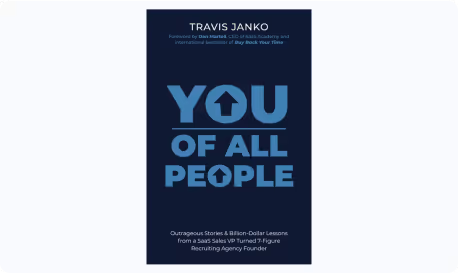
By Travis Janko, CEO of GSD Coach & Recruiting, helping SaaS founders build A-Player revenue teams. Fast.

Get more expert advice for SaaS founders on sales hiring, recruiting strategies, team leadership, and building high-performing sales teams.

Get started today with a free, no-obligation discovery call. Just fill out the form and share your revenue goals. We’ll be in touch within 24 business hours to show you how our proven systems can accelerate your hiring process.
.avif)


Our proven methodology has helped SaaS companies across every growth stage build revenue teams that drive predictable, scalable results. Connect with us to discover how we can accelerate your hiring process and deliver the A-Player talent your company needs to reach its next milestone.