We are witnessing a profound shift in what defines successful organizational leadership. The old top-down, "command and control" models are failing to keep up with the demands of the 21st-century economy. Today’s landscape requires more than just organizational authority; it demands a system built on unique value, trust, and influence. We recently distilled the key insights from a PMI.org webinar titled "Redefining Purpose & Leadership for the 21st Century." The session perfectly encapsulated the movement we support at GSD Coach & Recruiting: shifting from transactional management to powerful, networked leadership. Here is the blueprint for the modern leader.
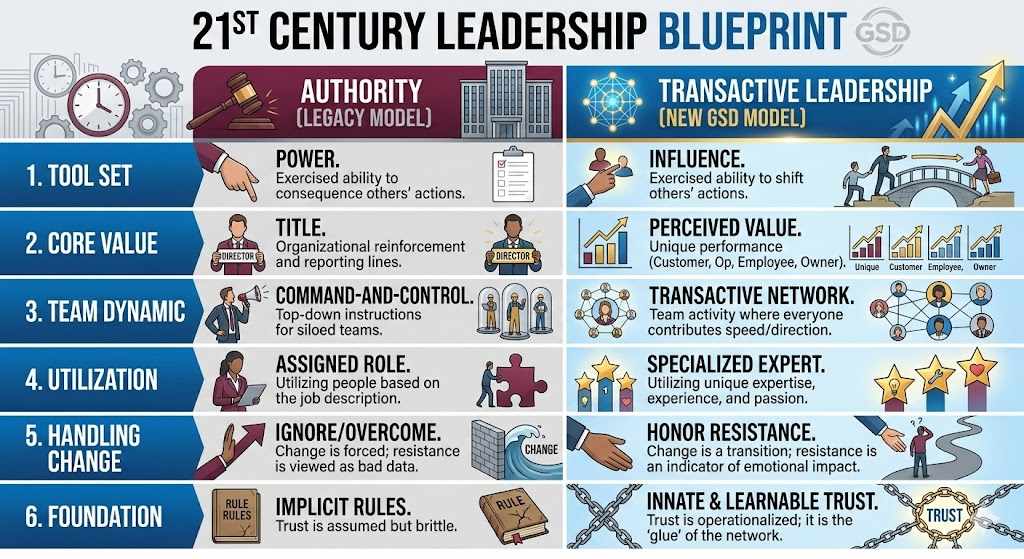
Your organization cannot simply "do the work." In a crowded market, value is the primary discriminator between success and stagnation.
Modern leadership is a value-driven performance. This performance must be unique, specialized, and clearly perceived by every single stakeholder. If you (or your team) are not explicitly delivering value in these four key domains, you are falling behind:
Value is what shifts a contribution from "on paper" success to real-world performance.
Many leaders confuse these three critical terms. To navigate a modern organization, you must understand their unique functions:
Successful modern organizations rely heavily on influence and rarely on consequence.
The concept of the singular "Hero Leader" is dead. Complexity demands a different approach: TransActive Leadership.
TransActive Leadership understands that leadership is a team activity that must scale beyond any individual project or manager.
In this model, everyone contributes to the speed and direction of the outcome. How? By operating within their unique area of expertise, experience, and passion. This is not passive participation; it’s networked action.
Why TransActive Leadership Wins (Especially for Remote/Global Teams): In a global, dispersed environment, command-and-control is impossible. TransActive Leadership creates distributed ownership. Teams coordinate through a shared area of expertise rather than waiting for instructions from the top.
If you want to implement change effectively, you have to understand that people do not resist change. What people resist is the IMPACT of the change on them.
Change leaders understand the difference. They respect that everyone goes through their own emotional cycle when facing the new. They understand that resistance is not "bad"—it is natural, healthy, and normal.
Effective transition and implementation do not happen by erasing resistance. Change leaders are successful because they honor the resistance as an indicator of an emotional cycle. They respect the transition time required for a transition to stick.
None of these concepts—TransActive teams, high-perceived value, or respectful change—exist without Trust.
As the webinar neatly summarized, Trust is the glue of life. It is innate, meaning we naturally grant a baseline level, but it is also a powerful, learnable skill.
At GSD-Coach, we focus on operationalizing that skill. Trust is built through:
When trust is the baseline skill, influence scales, authority recedes, and networked teams start to truly get things done.
By Angie Janko, COO of GSD Coach & Recruiting, helping SaaS founders build the top 5% of talent, FAST!

Get more expert advice for SaaS founders on sales hiring, recruiting strategies, team leadership, and building high-performing sales teams.

Get started today with a free, no-obligation discovery call. Just fill out the form and share your revenue goals. We’ll be in touch within 24 business hours to show you how our proven systems can accelerate your hiring process.
.avif)


Our proven methodology has helped SaaS companies across every growth stage build revenue teams that drive predictable, scalable results. Connect with us to discover how we can accelerate your hiring process and deliver the A-Player talent your company needs to reach its next milestone.