
A Performance Improvement Plan (PIP) should never be a shock to your sales rep. If it is, the failure isn’t theirs—it’s yours as a leader. This guide breaks down why leaders avoid uncomfortable performance talks, the hidden cost of delaying them, and a simple, 3-part framework to ensure your reps always know exactly where they stand before a formal PIP is ever drafted.
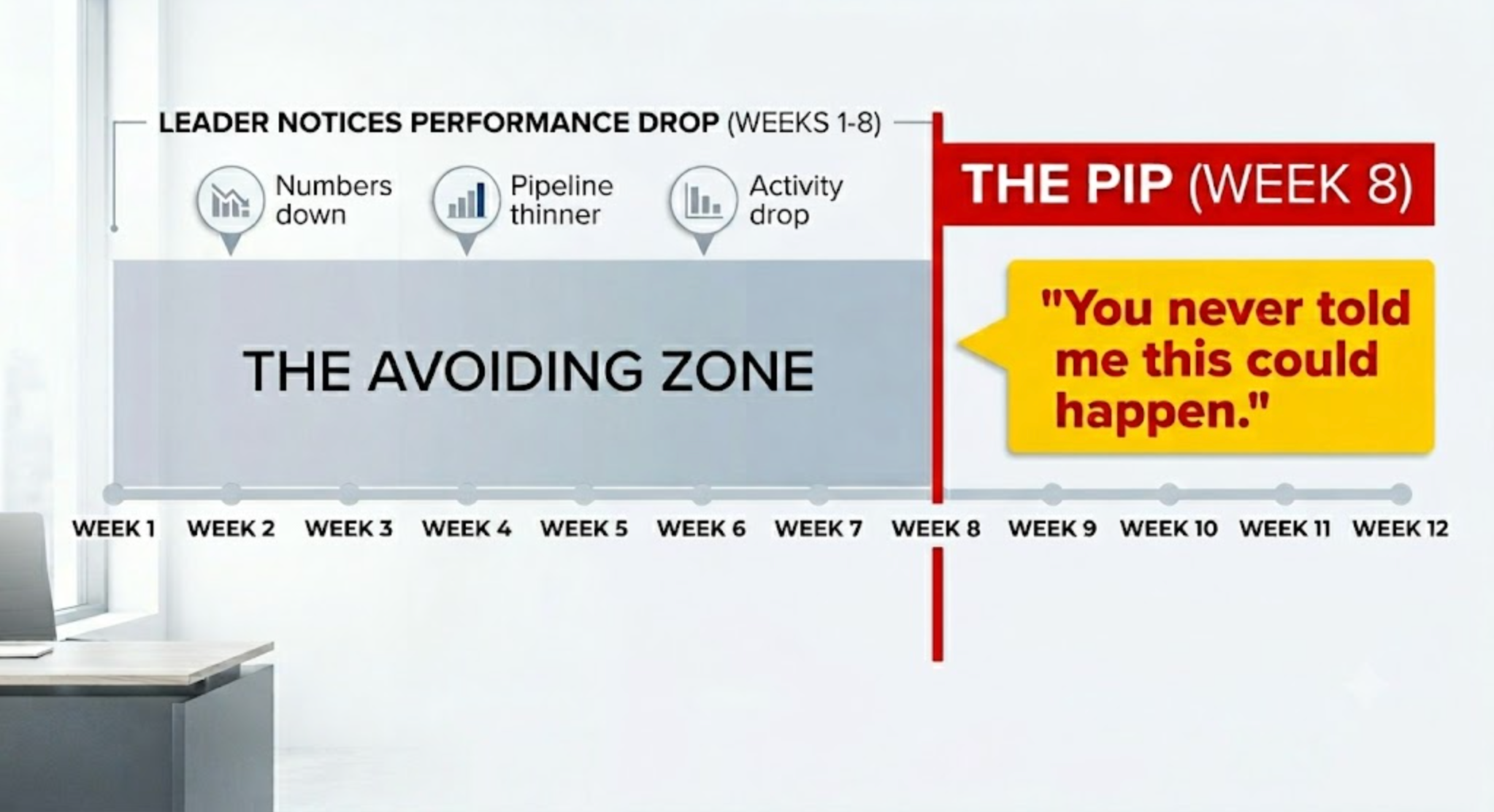
"You never told me this could happen."
That's what one of my reps said when I put him on a performance improvement plan, and he was right. I knew he wasn't performing. I was coaching him in one-on-ones, checking the boxes, and doing all the things that looked like leadership from the outside. What I wasn't doing was having the real conversation, the one that told him his job was at risk.
I didn't have it because I didn't want to have it. It was uncomfortable. I kept telling myself the coaching would turn things around, and that I just needed to give it more time. When it was finally time to put him on a PIP, he looked at me and said those seven words: You never told me this could happen. That one stayed with me because I knew exactly why I hadn't told him.
I was protecting myself, not him.
He deserved to know weeks earlier. I just wasn't willing to say it. That experience changed how I think about performance conversations forever.
Most leaders know when someone is struggling. They see the numbers, the pipeline, and the activity drop. And then they wait. They wait for next month, they wait for the next one-on-one, or they wait for the quarter to end. But the conversation never gets easier. The stakes just get higher.
By the time a PIP arrives, most reps have been struggling for weeks or months. They've felt the pressure building and they've sensed something is wrong, but because nobody said it directly, they've been filling in the blanks themselves. Sometimes they convince themselves things are fine, and other times they're quietly interviewing somewhere else. Either way, they're operating without the information they need to make a real decision about their future.
A PIP should never be the first time someone hears their job is at risk. If it is, the failure isn't the rep's. It's the leader's.
Most leaders avoid direct performance conversations because they're afraid of how they'll land. They soften the message, cushion it with positives, and talk around the concern instead of naming it. They leave the meeting thinking they said something important, while the rep walks out thinking everything is basically fine. The rep isn't failing to hear the message; the leader is failing to say it.
Here's the conversation I wish I'd had sooner. I call it the No-Surprise Conversation, and it has three distinct parts.
First, name the gap directly. Not "I've noticed your numbers have been a little soft lately." That's a cushion, not a conversation. Something closer to:
"I want to talk about where you are right now because I'm genuinely concerned. Your pipeline is down, your close rate has dropped, and the last three months haven't been where they need to be. I want to understand what's happening and I want to be honest with you about what I'm seeing."
That's the conversation. It's direct, it's specific, and it's honest. It gives the rep exactly what they need to understand the situation clearly.
Next, name the stakes. This is the part most leaders skip entirely. After naming the gap, say what it means. Not as a threat, but as a fact:
"If we don't see a significant change in the next thirty to sixty days, we're going to have a harder conversation about whether this role is the right fit. I don't want that conversation. But I want you to know where we are so you can make informed decisions about what comes next."
That sentence is the one that changes everything. It tells the rep clearly that their job is at risk, it gives them agency, and it removes the ability for anyone to say later that they didn't know.
Finally, document it. Not in a formal HR way. Just an email after the conversation:
"Hey, wanted to follow up on our conversation today. As we discussed, I'm concerned about where things stand and I want to make sure we're aligned on what needs to change over the next thirty days. Here's what we talked about."
That email protects both the rep and the leader. It creates a record of the conversation, and it makes sure nothing gets misremembered.
When the No-Surprise Conversation is handled correctly, the actual PIP should feel almost anticlimactic. The rep already knows they've been struggling, they already know the stakes, and they've already had the direct reality check. The PIP is just the formal documentation of something both people have already discussed honestly. If the PIP feels like a shock, it means the real conversation never happened.
Before putting anyone on a PIP, ask yourself one question: Have I told this person clearly and specifically that their job is at risk? Not implied it, not hinted at it, and not talked around it in a performance review. Said it directly in a conversation where there was no way to misunderstand. If the answer is no, have that conversation first. Give the rep a genuine chance to respond to information they actually have. Then, if nothing changes, the PIP is the next step and nobody is surprised by it.
The hardest part of this isn't knowing what to say. It's being willing to say it early enough to matter.
Most leaders wait too long because the conversation is uncomfortable. But the rep sitting across from you deserves to know where they stand. They have rent to pay, they have families to support, and they have career decisions to make. The conversation you're avoiding isn't protecting them; it's just making the eventual conversation harder for everyone.
Have it early.
Have it directly.
Have it honestly.
A PIP should never be the first time someone hears their job is at risk.
By Travis Janko, CEO of GSD Coach & Recruiting. We help SaaS founders build A-Player revenue teams through evidence-based hiring systems.

Get more expert advice for SaaS founders on sales hiring, recruiting strategies, team leadership, and building high-performing sales teams.


Get started today with a free, no-obligation discovery call. Just fill out the form and share your revenue goals. We’ll be in touch within 24 business hours to show you how our proven systems can accelerate your hiring process.
.avif)


Our proven methodology has helped SaaS companies across every growth stage build revenue teams that drive predictable, scalable results. Connect with us to discover how we can accelerate your hiring process and deliver the A-Player talent your company needs to reach its next milestone.