
Most hiring decisions are made on gut feel. The problem is that gut feel leaves no evidence behind. When a hire succeeds, you cannot replicate it. When a hire fails, you cannot explain it. In this article, Travis Janko shares the simple hiring audit trail framework that helps SaaS founders replace opinions with evidence and build a repeatable hiring system.
A few years ago, I was speaking with a founder about a sales hire that hadn't worked out. The rep had been with the company for roughly six months. He missed quota, struggled to gain traction, burned through valuable opportunities, and eventually the company decided to move on.
As we talked through what happened, I asked a simple question.
"Why did you hire him?"
The founder paused for a moment before answering.
"Honestly, Travis, I don't know. He just felt right."
That answer stuck with me.
Not because the hire failed. Every leader who hires enough people will eventually make a hiring mistake. What bothered me was something else entirely. There was no way to learn from it.
If the hire had worked, he couldn't explain why.
If the hire failed, he couldn't explain why.
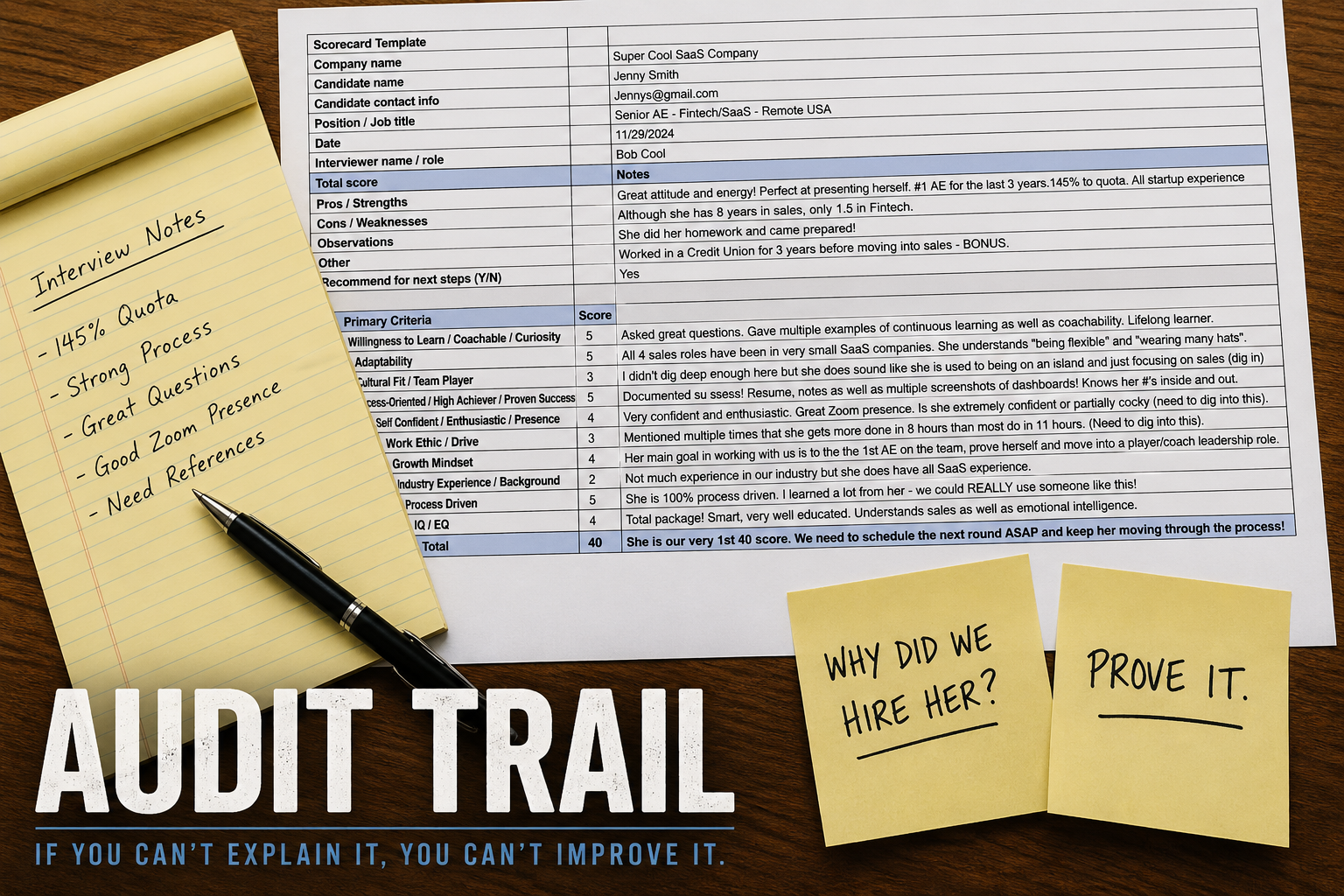
There was no documented evidence, no scorecard, no objective record of what separated that candidate from everyone else in the process. The decision had been made on instinct, and once the outcome was known, there was nothing left to examine.
The more founders I spoke with, the more common I realized this problem was.
Most companies have systems for everything that matters.
Sales teams use CRMs to track opportunities, forecast revenue, and understand why deals are won or lost. Financial decisions are documented through budgets, forecasts, and reporting. Marketing teams track campaign performance, conversion rates, and attribution.
Everything leaves a trail.
Hiring, however, is often different.
A candidate interviews with several people. The team shares opinions. Someone says they seem sharp. Someone else says they would fit the culture. Another person says they have a good feeling about them.
Eventually a decision gets made.
Months later, if someone asks why Candidate A was hired over Candidate B, very few organizations can answer with anything more substantial than a collection of impressions.
That is where many hiring mistakes begin.
To be clear, I am not arguing against judgment.
Experienced leaders should use judgment. Experience matters. Pattern recognition matters. Instinct matters.
The problem arises when judgment becomes the entire process.
When that happens, successful hires become difficult to replicate because nobody can clearly explain what made them successful in the first place. Failed hires become equally difficult to diagnose because there is no evidence showing where the process broke down.
Judgment needs evidence underneath it.
Without evidence, hiring becomes difficult to improve because there is nothing to learn from.
An effective hiring process leaves evidence behind at every stage. In our experience, three components matter most.
Before a search begins, there should be a clear definition of success.
Not broad descriptions like "hunter mentality" or "culture fit."
Specific evidence.
What type of customer has this person sold to? What deal sizes have they managed? What sales cycle are they familiar with? What type of environment have they succeeded in before?
The clearer the profile, the easier it becomes to evaluate candidates consistently.
Every interviewer should be evaluating candidates against the same criteria.
Otherwise, each person is using their own definition of what good looks like.
A scorecard creates consistency. It forces interviewers to document what they observed, what was validated, and what concerns emerged during the process.
The goal is not to eliminate judgment. The goal is to make judgment visible.
Candidates make claims throughout every interview.
They are resilient.
They are coachable.
They are top performers.
The question is always the same.
What is the evidence?
Can they provide a specific example? Can they explain what happened, what they learned, and what measurable outcome resulted?
The strongest hiring decisions are built on evidence, not adjectives.
Many leaders focus on improving interview questions.
The bigger opportunity is improving hiring decisions.
A great hiring process creates a record of why decisions were made. It creates consistency across interviewers. It creates evidence that can be reviewed months later when evaluating outcomes.
Six months after a hire, every founder should be able to answer two simple questions.
Why did we hire this person?
Why didn't we hire everyone else?
If those questions cannot be answered clearly, there is a good chance the hiring process relied more on memory than evidence.
And memories are difficult to scale.
By Travis Janko, CEO of GSD Coach & Recruiting, helping SaaS founders build the top 5% of talent, FAST!

Get more expert advice for SaaS founders on sales hiring, recruiting strategies, team leadership, and building high-performing sales teams.

Get started today with a free, no-obligation discovery call. Just fill out the form and share your revenue goals. We’ll be in touch within 24 business hours to show you how our proven systems can accelerate your hiring process.
.avif)


Our proven methodology has helped SaaS companies across every growth stage build revenue teams that drive predictable, scalable results. Connect with us to discover how we can accelerate your hiring process and deliver the A-Player talent your company needs to reach its next milestone.